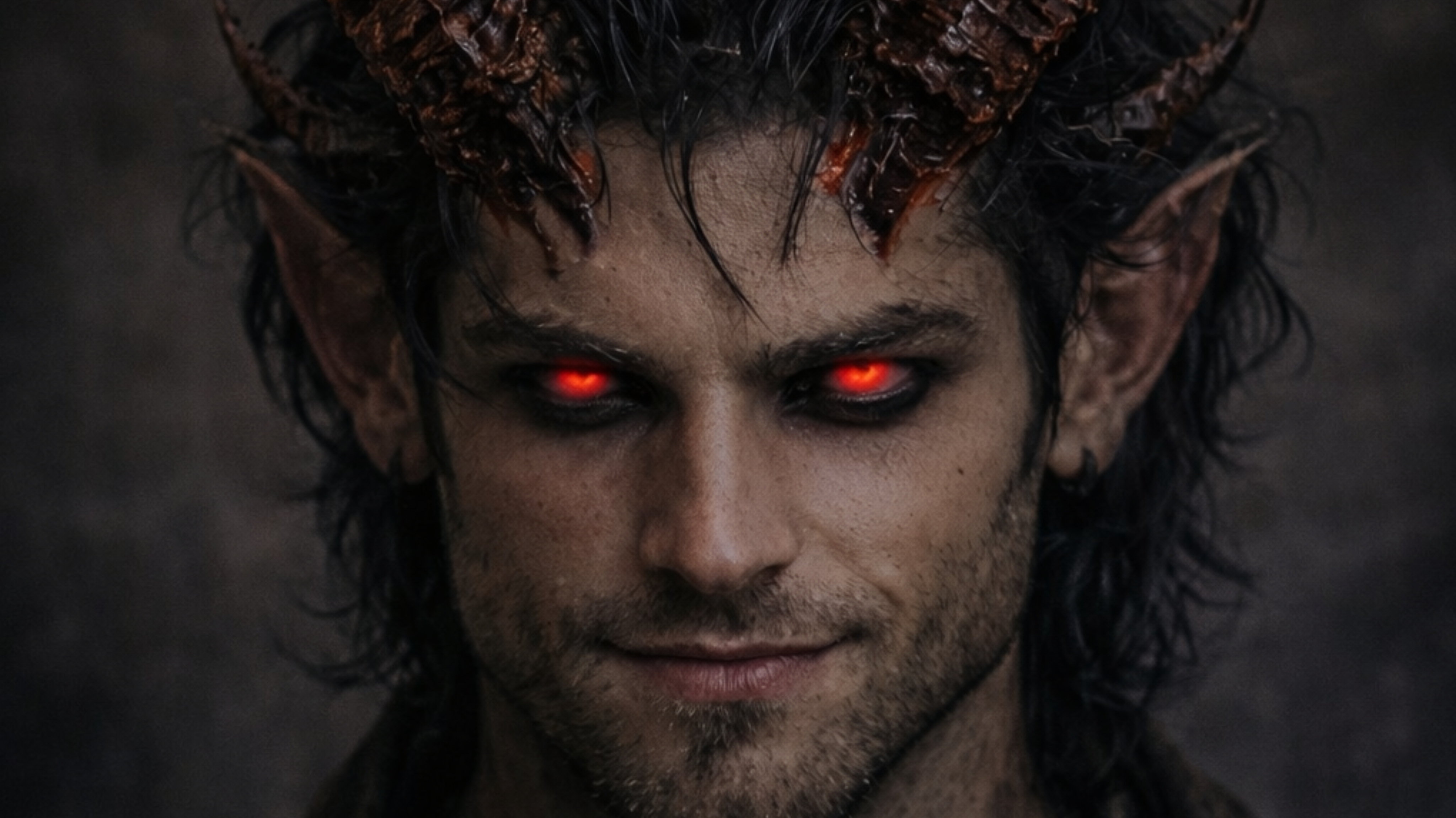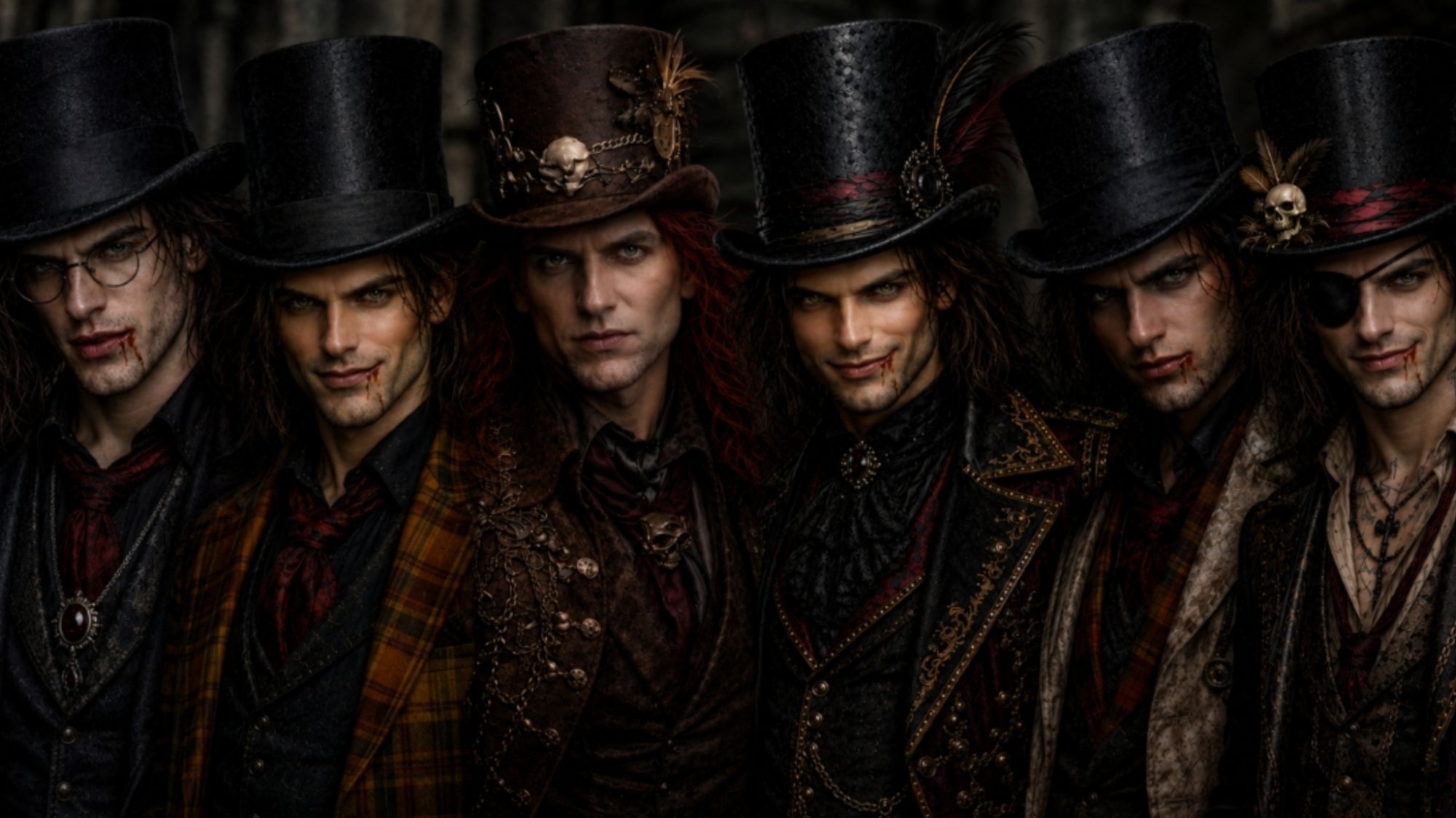
The Nicolai are not merely alters, servants, or companions of Nicolas DeSilva. They are Nicolas. Two hundred and sixteen bodies, professions, personalities, obsessions, and specialisations woven into a single immortal organism. Some command ships, some build castles, some investigate murders, some write propaganda, and some would happily serve your relatives for dinner if given the opportunity. Together they form one of the most unusual and dangerous entities in the Immortalis universe. Bound by a shared consciousness yet capable of rivalry, loyalty, love, jealousy, and outright civil war, the Nicolai reveal every facet of Nicolas’s fractured nature. What follows is a guide to twenty of the most prominent Nicolai, from trusted advisers and master craftsmen to criminals, hunters, sailors, doctors, and monsters, each contributing something unique to the ever-expanding chaos of Corax Asylum.
NICOLAS DESILVA
Nicolas DeSilva is the dominant Immortalis, the governing self of the Nicolai collective, Master of Corax Asylum, father of Absolem, and the central body from which the remaining Nicolai extend. Although outsiders often describe the Nicolai as alters, personalities, or separate men, the reality is considerably stranger. Nicolas is the body and the Nicolai are the tentacles. Each possesses an independent physical form, personality, profession, and purpose, yet all remain psychically connected to Nicolas and ultimately part of the same organism. There are two hundred and sixteen Nicolai in total, sometimes called Old Nics, Nicolases, or simply the Nicolai. Every sensation, memory, triumph, embarrassment, failure, and indulgence eventually returns to Nicolas.
His existence began as part of a scheme. Primus, the Darkness, arranged Nicolas’s conception through a strategic union with a Baer warrior, Boaca Baer, in order to create a counterweight to his brother Theaten. Nicolas therefore entered the world not through affection but through calculation. He was removed from his mother at a young age and eventually found his way to Irkalla, where much of his education occurred. It was there that he was exposed to beings, ideas, and influences that would shape the rest of his existence. Among the most significant of these influences was the Djinn Ibliss, whose presence would leave a lasting mark on Nicolas’s development.
By the time Nicolas reached twelve years of age, he had already existed for years in a merged state with Chester. Chester was not simply another personality waiting to emerge. He was Nicolas’s Evro, his primal counterpart, and the first extension of the greater creature. The two existed together until Nicolas learned how to separate himself in Irkalla. This event fundamentally changed the course of his life. What had once been one being became two physically distinct entities. More importantly, Nicolas realised that separation itself could become a tool.
The creation of the wider Nicolai collective emerged gradually from this discovery. Nicolas was fully capable of designing and producing new Nicolai himself, but he rapidly lost interest in the repetitive labour involved. Once Archie the Architect had been developed and proven competent, much of the responsibility for designing future Nicolai was delegated to him. This arrangement suited both of them. Nicolas preferred grand designs and larger schemes, while Archie enjoyed the process of construction and refinement. Over centuries the collective expanded. Specialists appeared. Doctors, sailors, hunters, journalists, chefs, detectives, musicians, engineers, propagandists, and countless other variations of Nicolas entered existence. Each served a purpose. Each reflected some aspect of the greater whole.
Unlike Theaten and Lilith, Nicolas never pursued power for its own sake. He pursued control. This distinction defines much of his character. He dislikes uncertainty, dislikes variables, and dislikes situations that cannot be directed towards a desired outcome. When confronted with obstacles, Nicolas rarely seeks to destroy them outright. Instead he alters the environment until the obstacle ceases to function as intended. This tendency can be observed in his politics, his architecture, his relationships, and even his romances.
Corax Asylum stands as the greatest physical expression of this mindset. Originally a palace, it was transformed into Nicolas’s domain and became one of the most infamous locations in The Deep. Corax is simultaneously residence, prison, laboratory, theatre, fortress, and psychological machine. Hidden passages run through its structure. Secret chambers exist within secret chambers. Entire sections are known only to the Nicolai. Archie helped shape much of the architecture, but Corax ultimately remains Nicolas’s creation and under his authority. He governs it directly. Chives serves him there as ghoul, manservant, henchman, and whatever else Nicolas requires on a given day. Notably, Chives obeys Nicolas while largely ignoring the Nicolai, a fact that occasionally irritates them, and Nicolas.
Nicolas possesses an extraordinary collection of talents. He is a shape-shifter, illusionist, performer, strategist, manipulator, predator, and organiser. He enjoys theatre almost as much as he enjoys victory. Elaborate spectacles, carefully staged encounters, dramatic entrances, and absurdly complicated schemes all appeal to him. His sense of humour is frequently as dark as his methods. He can move seamlessly from horrific acts to ridiculous conversations without perceiving any contradiction between them.
Many of the darker aspects of Nicolas’s character become visible through his treatment of the Immolesses. His fascination with them predates Allyra and forms part of a much larger pattern of obsession, control, and curiosity. Yet Allyra ultimately becomes different. What begins as interest evolves into fixation and eventually into one of the defining relationships of the series. Nicolas falls deeply in love with Allyra, but his understanding of love is inseparable from ownership. He wishes to protect her, guide her, educate her, keep her safe, and ensure her happiness. He also wishes to control where she goes, who she sees, what she believes, and whether she can leave. To Nicolas these desires do not conflict. To everyone else they very clearly do.
The arrival of Allyra destabilises the collective in ways Nicolas never anticipated. The Nicolai all experience her differently. Some become protective. Some become fascinated. Some become infatuated. Some become jealous. Nicolas expects the collective to remain united, but Allyra gradually creates divisions. Nicodemus becomes her favourite. Bigglesworth falls hopelessly in love with her. Chester develops his own attachment. Other Nicolai take sides in disputes that would have been unthinkable before her arrival. The result is the first genuine internal crisis the collective experiences.
Absolem further complicates matters. The child of Nicolas, Chester, and Allyra, Absolem becomes one of the most important figures in the wider mythology. His upbringing is anything but conventional. Archie and Pauley help oversee his development away from Allyra, allowing him to mature at an extraordinary rate in another time dimeension located in Irkalla, The Chronocell. Nicolas regards many of these decisions as practical necessities. Others view them rather differently.
As the series progresses, Nicolas increasingly finds himself challenged by forces both external and internal. The Milkmaids, Tempestas and Primus emerge as significant threats. Yet the most personal challenge comes from Nicodemus. What begins as favouritism gradually becomes rivalry. Nicolas initially attempts to manage the situation rather than confront it directly. When Behmor offers Castle Tepes to him following the abandonment of the fortress, Nicolas redirects the gift to Nicodemus, hoping responsibility and distance will reduce the problem. Instead it gives Nicodemus territory, authority, and independence.
The decision ultimately backfires. Castle Tepes becomes Castle Demus. Nicodemus becomes increasingly bold. Schemes multiply. Manipulations escalate. Allyra becomes the centre of a conflict that eventually threatens to fracture the collective itself. By the time of The Fractured King, Nicolas is no longer merely defending a relationship. He is defending the structure of the Nicolai.
Despite his many faults, Nicolas remains enormously charismatic. He inspires loyalty, affection, terror, admiration, and hatred in roughly equal measure. Many who encounter him find themselves fascinated despite recognising the danger. He is capable of extraordinary generosity and extraordinary cruelty, sometimes within the same conversation. He can be protective, affectionate, and genuinely funny, only to become manipulative or terrifying moments later. This unpredictability is part of what makes him so difficult to resist and so dangerous to trust.
Beneath every scheme, every performance, every romance, every war, and every act of horror lies the same fundamental truth. Nicolas does not see himself as fragmented. He sees himself as expanded. The Nicolai are not separate from him. They are him. A sprawling, immortal, theatrical organism spread across hundreds of bodies, each pursuing its own purpose while remaining connected to the same monstrous heart.
CHESTER DESILVA
Chester DeSilva is the Evro of Nicolas DeSilva, the oldest and largest member of the Nicolai collective (his biggest dick), and one of the most influential figures within the greater organism. Unlike most Nicolai, who were deliberately designed and produced over time, Chester predates the collective itself. Before there were doctors, sailors, architects, detectives, propagandists, hunters, and musicians, there was Chester. He existed alongside Nicolas from the beginning and remained merged with him throughout Nicolas’s early life.
For the first twelve years of Nicolas’s existence, Chester and Nicolas shared a single body. The separation that eventually occurred in Irkalla was one of the defining moments in both their lives. When Nicolas learned how to separate himself from his Evro, Chester became an independent physical entity while remaining psychically linked to the central body. The event created the template from which the entire Nicolai system would eventually emerge. Every later Nicolai owes its existence, directly or indirectly, to the precedent established by Chester.
As the Evro, Chester embodies the primal aspects of the collective. He is instinctive where Nicolas is calculating, direct where Nicolas is theatrical, and honest where Nicolas is manipulative. This does not make him morally superior. Chester is frequently described as a cad, a lech, vindictive, selfish, and deeply inappropriate. He simply lacks Nicolas’s tendency to disguise his motivations beneath elaborate justifications. If Chester wants something, he usually says so.
This quality makes him oddly trustworthy despite his many flaws. People often understand where they stand with Chester. They may not like the answer, but they usually receive one. Nicolas, by contrast, can spend weeks constructing a scheme before revealing what he wanted all along. Chester rarely has the patience for such behaviour.
Within the collective Chester occupies a position second only to Nicolas himself. His status comes partly from age, partly from history, and partly from the simple fact that he is the largest of the Nicolai tentacles. While every Nicolai possesses an independent body, Chester’s physical and symbolic significance exceeds that of most others. He is the oldest surviving extension of the organism and remains intimately tied to Nicolas in ways no later creation can fully replicate.
Chester’s influence extends across numerous aspects of Nicolai life. One of his most notorious habits is sabotaging the schemes of Pauley the Cheese. Pauley may spend months organising a criminal enterprise only for Chester to interfere, disrupt the plan, or create chaos simply because he feels like it. This recurring conflict contributes greatly to the absurd internal politics of the collective and ensures that even Nicolas’s own organisation rarely functions as smoothly as intended.
His relationship with Allyra becomes one of the most significant developments in his later life. Like many Nicolai, Chester falls in love with her, though his affection manifests differently from Nicolas’s possessiveness or Bigglesworth’s quiet devotion. Chester’s attraction is immediate, enthusiastic, and unapologetically direct. He forms part of the complicated relationship that eventually leads to the birth of Absolem and remains deeply involved in the child’s existence.
Unlike some Nicolai, Chester does not seek independence from Nicolas. He may argue, complain, interfere, and occasionally cause disasters, but he fundamentally accepts the nature of the collective. He understands what he is and has little interest in becoming something else. This places him in direct contrast to Nicodemus, whose growing desire for Allyra eventually develops into a challenge to the existing order.
Nicolas places restrictions on certain merges involving Chester. When combined with Nicolas or Smythe, behavioural extremes increase dramatically. The resulting configurations become difficult even for the collective to manage. These limitations are not imposed for ethical reasons. They exist because the consequences become impractical.
Despite his crude behaviour and frequent absurdity, Chester performs an essential function within the collective. He prevents it from becoming sterile. He introduces unpredictability, humour, instinct, and emotional immediacy into a system otherwise dominated by planners, strategists, and specialists. Without Chester the Nicolai might become more efficient, but they would also become less alive.
His sense of humour is particularly influential. Chester delights in embarrassing other Nicolai, exposing hypocrisies, provoking reactions, and generally making life more complicated than necessary. He enjoys chaos for its own sake. This tendency frequently creates problems for Nicolas, though even Nicolas occasionally benefits from disruptions that prevent schemes from becoming too rigid.
Chester also remains one of the few Nicolai capable of challenging Nicolas directly without creating genuine instability. Their relationship predates every other member of the collective. They have shared existence, separation, triumphs, failures, romances, humiliations, and centuries of accumulated memories. Arguments between them rarely threaten the organism because both understand each other too well.
In many ways Chester represents the oldest truth about Nicolas. Before the asylum, before the politics, before the hundreds of specialised bodies, there was the simple reality that Nicolas possessed instincts he could never entirely control. Chester gave those instincts a face, a voice, and eventually a body of their own.
He remains one of the most recognisable Nicolai because he is simultaneously ridiculous, dangerous, affectionate, selfish, loyal, and impossible to ignore. Whether sabotaging Pauley’s businesses, irritating Nicolas, pursuing Allyra, helping raise Absolem, or simply causing trouble for everyone around him, Chester continues to embody the chaotic heart of the collective.
Chester is also known as The Nasty Tongue-Monster, The Pied Piper, The Postman, The Cat, and plain old Ches. The former names are awards given for his sensual abilities with his tongue and his flute. All the ladies love Chester, and he only kills the ones that cheat before he has finished with them.
DR NICODEMUS
Dr Nicodemus is one of the most important and dangerous members of the Nicolai collective. Although he began existence as another specialised Nicolai, his story gradually develops into something far more significant. Among all the Nicolai, Nicodemus comes closer than any other to becoming a genuine rival to Nicolas himself. His rise begins quietly, continues across multiple books, and eventually develops into a conflict capable of threatening the entire structure of the collective.
Originally created as Nicolas’s anatomical specialist, Nicodemus possesses an exceptional understanding of biology, medicine, physiology, and the human body. His ability to excite women, profound. Unlike Smythe, whose genius often struggles against addiction and personal instability, Nicodemus remains highly focused and intensely driven. His talents make him invaluable to the collective, particularly in areas involving experimentation, treatment, anatomy, and medical procedures. Over time he also becomes involved in the development of specialised ashurrel strains alongside Absolem and participates in numerous medical and scientific projects throughout Corax and beyond.
From the beginning, however, Nicodemus possesses a quality that distinguishes him from many of the other Nicolai. He develops genuine personal attachments. Most Nicolai are capable of affection, attraction, and loyalty, but Nicodemus increasingly experiences these feelings as individual desires rather than collective ones. This difference appears most clearly in his relationship with Allyra.
Allyra quickly develops a preference for Nicodemus. Among the countless Nicolai surrounding her life, Nicodemus becomes her favourite and eventually rises to the position of Maitre en Titre. What begins as favouritism gradually becomes something much more significant. Allyra enjoys his company. She trusts him. She values his attention. While Nicolas initially tolerates this development, he quickly realises that Nicodemus is becoming a problem.
Unlike Bigglesworth, who accepts his feelings and remains loyal to the collective, Nicodemus begins wanting more. He does not merely enjoy Allyra’s company. He wants her attention. Then he wants her time. Eventually he wants Allyra herself. The distinction becomes increasingly important. For the first time a Nicolai begins pursuing an objective that is not entirely aligned with Nicolas’s own interests.
This development creates a growing rivalry between the two. Nicolas experiences everything Nicodemus experiences, understands precisely what is happening, and increasingly dislikes what he sees. Yet rather than confronting the issue directly, Nicolas attempts to manage it. Following the events surrounding Castle Tepes, Behmor wishes to gift the abandoned fortress to Nicolas. Already concerned by Nicodemus’s growing fixation, Nicolas redirects the gift to him instead.
The decision proves disastrous.
Nicolas hopes that responsibility, territory, and independence will distract Nicodemus from Allyra. Instead Castle Tepes provides exactly the resources Nicodemus needs to become more dangerous. He gains a domain of his own. He gains distance from Corax. He gains authority. Most importantly, he gains somewhere that does not belong to Nicolas.
Over time Castle Tepes evolves into Castle Demus, becoming increasingly associated with Nicodemus himself. Rather than calming his obsession, the castle allows it to grow.
The situation starts to escalate during the events of Revenge of the Vigilante Milkmaids. At this stage Nicodemus has already begun actively engineering circumstances to maximise his access to Allyra. One of the most revealing examples involves Carmilla’s capture of her.
Nicodemus deliberately tips off Carmilla and ensures he is present when the capture occurs. Under Nicolai rules, Allyra must always have two guardians. The purpose of this rule is obvious. No single Nicolas should ever gain unrestricted access to her. The rule exists specifically to prevent the sort of situation Nicodemus wants.
Nicodemus solves the problem through manipulation.
He ensures that Smythe serves as the second guardian.
He also ensures that Smythe is heavily medicated.
Smythe is therefore physically present while effectively incapable of interfering. Technically the rule remains intact. Practically Nicodemus has engineered a situation in which he gains exactly what he wants. Allyra becomes isolated with him for an extended period while collective safeguards are rendered meaningless.
This moment marks an important turning point in his character. Nicodemus is no longer reacting to opportunities. He is creating them.
As his relationship with Allyra develops, Nicodemus increasingly begins imagining a future that excludes Nicolas. This progression occurs gradually rather than suddenly. He does not wake up one morning intending to challenge the collective. Instead he moves step by step from affection to desire, from desire to entitlement, and from entitlement to action.
The third book pushes this process to its logical conclusion.
While larger threats such as Tempestas and Primus dominate much of the wider narrative, Nicodemus pursues his own agenda. By this stage Castle Demus has become firmly established as his domain and his obsession with Allyra has reached the point where coexistence is no longer enough.
He kidnaps her.
The act represents the greatest challenge ever posed to Nicolas by one of his own Nicolai. Nicodemus removes Allyra from Corax, takes her to Castle Demus, and attempts to create circumstances in which she exists beyond Nicolas’s immediate reach. What began as favouritism has become outright rebellion.
Ironically, many of Nicodemus’s methods mirror Nicolas’s own. He manipulates events. He engineers circumstances. He exploits rules rather than breaking them outright. He positions himself advantageously and removes obstacles before acting. The difference lies not in methodology but in objective. Nicolas manipulates reality to keep Allyra. Nicodemus manipulates reality to take her.
The resulting conflict forms the foundation of The Fractured King.
By this stage the dispute has evolved far beyond a simple romantic rivalry. The future of the collective itself becomes involved. If Nicodemus can successfully pursue a personal objective against Nicolas’s wishes, then the fundamental nature of the Nicolai changes. The organism ceases to function entirely as one being. Individuality begins asserting itself.
Other Nicolai respond in different ways. Some support Nicolas. Some sympathise with Nicodemus. Some switch sides simply because the situation is entertaining. The resulting struggle becomes one of the most significant internal conflicts in the history of the collective.
Despite these developments, Nicodemus never ceases to be a Nicolas. This is what makes him so dangerous. He understands Nicolas better than almost anyone because he is Nicolas. He shares the same intelligence, the same strategic instincts, and many of the same flaws. His challenge emerges not from difference but from similarity.
Among all the Nicolai, Nicodemus comes closest to proving that the collective is capable of producing genuine rivals to itself. He begins as a doctor, becomes Allyra’s favourite, acquires a castle, manipulates events to gain access to her, kidnaps her, and eventually helps trigger a war that threatens to fracture the organism from within.
For a being originally created to understand anatomy, Nicodemus ultimately becomes an expert on a different subject entirely.
He discovers where the collective is weakest.
COMMODORE NICOLAS BIGGLESWORTH
Commodore Nicolas Bigglesworth is the master of The Erebus, Commodore of the Corax Armada, self-taught nautical genius, and one of Allyra’s most beloved Nicolai. Although frequently remembered for his maritime absurdity, oversized ambitions, and disastrous early naval career, Bigglesworth possesses one of the most emotionally significant stories within the entire collective.
Like all Nicolai, Bigglesworth exists as a specialised extension of Nicolas. His purpose is tied to the sea. Where Archie builds structures, Cedric investigates mysteries, and Felippe studies mines and explosives, Bigglesworth governs ships, navigation, maritime operations, naval logistics, and everything connected to life upon the water. The sea belongs to him in much the same way that Corax belongs to Nicolas.
His rise to the title of Commodore follows a suitably ridiculous path. After wrecking twenty fishing boats in the space of two weeks, Bigglesworth declared himself a nautical genius and awarded himself increasingly impressive titles. Within the collective this behaviour was considered entirely reasonable. After all, every asylum requires an armada.
Over time Bigglesworth becomes master of The Erebus and one of the most recognisable members of the collective. His ships travel throughout The Deep, extending Nicolai influence far beyond Corax. Unlike many Nicolai whose work remains hidden in laboratories, tunnels, forests, or newspapers, Bigglesworth’s domain is highly visible. He is explorer, pirate, naval officer, captain, smuggler, instructor, and occasional menace depending on circumstances.
His relationship with Allyra becomes one of the defining elements of his life.
Unlike Nicodemus, who gradually develops possessive ambitions, Bigglesworth’s feelings emerge quietly. He enjoys her company. He teaches her. He listens to her. He spends time with her aboard ships and during maritime journeys. What begins as companionship eventually becomes something much deeper.
Bigglesworth falls completely in love with Allyra.
The tragedy of this development is that he understands exactly what he is. He knows he is a Nicolai. He knows he is part of the collective. He knows Nicolas occupies the central position within Allyra’s life. He knows Nicodemus is pursuing her aggressively. He understands every obstacle standing before him.
Yet he falls in love anyway.
Rather than pursuing ownership, Bigglesworth chooses appreciation. He cherishes the time he receives. He treasures conversations. He values opportunities to teach her. Every lesson becomes important because he never assumes there will be another.
One of the areas in which he spends the most time with Allyra involves seamanship. Bigglesworth trains her in maritime skills, ship handling, navigation, and survival at sea. He introduces her to parts of the world she might otherwise never experience and gradually becomes one of her most trusted companions away from Corax.
He also teaches her how to ride Rachnoc, an undertaking that requires considerable patience, skill, and courage. These lessons create some of the strongest bonds between them and provide opportunities for the two to interact outside the influence of Nicolas and the wider collective.
Bigglesworth’s affection manifests in small gestures. He sends Allyra flowers. He remembers details. He values moments that many of the other Nicolai overlook. These acts irritate Nicolas considerably, though Bigglesworth rarely allows that fact to discourage him.
Despite his feelings, Bigglesworth remains loyal to the collective. This distinguishes him sharply from Nicodemus. While Nicodemus eventually decides he wants Allyra for himself, Bigglesworth never pursues that path. He understands the temptation. He simply refuses to follow it.
This loyalty becomes increasingly difficult as tensions rise between Nicolas and Nicodemus. By the time Castle Demus enters the picture, the collective has effectively begun dividing into factions. Alliances shift. Arguments intensify. Schemes multiply. Allyra finds herself caught in the middle of a conflict involving multiple versions of the same man.
Bigglesworth initially attempts to remain above the dispute. Eventually this becomes impossible.
As the conflict escalates, he increasingly finds himself acting not for Nicolas or Nicodemus but for Allyra herself. He becomes concerned less with who wins and more with what the war is doing to her.
This concern ultimately leads to one of the most significant actions of his life.
Bigglesworth steals Allyra away.
Unlike Nicodemus, who seeks possession, Bigglesworth seeks escape. He removes her from the conflict, from the scheming, and from the increasingly dangerous struggle between rival Nicolai factions. In doing so he becomes the target of pursuit.
Nicolas pursues.
Chester pursues.
Nicodemus pursues.
Three different manifestations of the same organism hunt the Commodore across sea and land while Allyra remains at the centre of the storm.
The situation perfectly captures the absurd tragedy of Bigglesworth’s life. He never wanted to challenge Nicolas. He never wanted a war. He never attempted to take Allyra for himself. Yet his love ultimately forces him into direct opposition to those he considers family.
Even during darker moments, Bigglesworth retains the eccentric humour that defines many Nicolai. He remains prone to grand ideas, questionable nautical decisions, and bizarre maritime solutions to problems that would be simpler on land. His enthusiasm frequently exceeds his caution, though this often contributes to his charm.
He also possesses a capacity for listening that many other Nicolai lack. While Nicolas speaks, plans, explains, and manipulates, Bigglesworth often listens. This quality helps explain why Allyra trusts him and why his feelings become so profound. He sees her as a person before he sees her as a problem to solve.
Among the Nicolai, Bigglesworth may possess one of the saddest love stories. He spends years loving Allyra while knowing he is unlikely to receive what he wants. He remains loyal despite disappointment, kind despite frustration, and supportive despite competition. Even when he finally acts, he does so to protect her rather than claim her.
The sea belongs to Bigglesworth. The Erebus belongs to Bigglesworth. The Corax Armada belongs to Bigglesworth.
Allyra never does.
And that is perhaps why he loves her so much.
PAULEY THE CHEESE
Pauley the Cheese is Nicolas DeSilva’s criminal mastermind, accountant, racketeer, fixer, and one of the most entrepreneurial members of the Nicolai collective. While many Nicolai specialise in professions that support Corax directly, Pauley’s interests tend to drift toward money, influence, corruption, and the complicated machinery required to keep illicit empires operating. If Nicolas governs the collective and Archie builds its infrastructure, Pauley is often responsible for ensuring somebody is making a profit from it.
Like all Nicolai, Pauley exists as a specialised extension of Nicolas. He was not created randomly. He was designed to fulfil specific functions that Nicolas found useful but tedious. Nicolas enjoys large schemes, political manipulation, and theatrical domination. He is far less interested in accountancy, bookkeeping, logistics, and the endless maintenance required to keep criminal enterprises profitable. Pauley emerged to fill that gap.
His title is not metaphorical. Pauley genuinely possesses an unusual fascination with cheese and frequently incorporates it into his businesses, identities, and schemes. Like many Nicolai, he embraces absurdity rather than avoiding it. This tendency often makes outsiders underestimate him. Unfortunately for them, Pauley is far more intelligent than his eccentric appearance suggests.
Over centuries Pauley establishes himself as the principal manager of various DeSilva criminal operations. Smuggling, racketeering, extortion, black-market ventures, laundering operations, illicit trade, and questionable business enterprises frequently find their way under his supervision. His responsibilities expand so dramatically that he effectively becomes the financial backbone of numerous Nicolai projects.
Unfortunately for Pauley, his greatest enemy is not law enforcement.
It is Chester.
Throughout his existence Pauley has suffered from Chester’s constant interference. Elaborate criminal schemes that take months to organise can collapse in days because Chester becomes bored, distracted, interested in somebody else, or simply decides that ruining Pauley’s plans would be amusing. This creates one of the longest-running internal feuds within the collective.
Pauley’s frustration is entirely understandable. He may spend months building a profitable operation only to discover that Chester has somehow turned the situation into a disaster. While Nicolas occasionally finds these events irritating, he also finds them entertaining enough that he rarely intervenes.
The arrival of Allyra introduces additional complications into Pauley’s life. Unlike some Nicolai, Pauley never becomes one of her primary favourites. Nevertheless, she quickly becomes impossible to ignore because her presence increasingly influences every major decision within the collective. Financial plans, political manoeuvres, and territorial disputes all begin revolving around her in some fashion.
One of Pauley’s most important contributions involves Absolem.
Following Absolem’s birth, Pauley becomes one of the figures involved in raising him away from Allyra. Working alongside Archie, he helps oversee the unusual development process that allows Absolem to mature at an extraordinary rate. The arrangement deprives Allyra of much of her son’s early childhood, a decision that Pauley and the other Nicolai justify as practical necessity.
From Pauley’s perspective, the arrangement makes perfect sense.
From Allyra’s perspective, the matter is somewhat more complicated.
His involvement in Absolem’s upbringing reveals an important aspect of his character. Beneath the criminality, greed, and endless schemes lies a surprisingly capable administrator. Pauley excels at organising systems, managing resources, and solving practical problems. This makes him useful in situations far removed from ordinary criminal enterprise.
His professional relationship with Smythe is particularly notable. Smythe frequently accumulates debts through gambling, addiction, or poor decision-making, forcing Pauley to deal with increasingly frustrated bookies and creditors. The resulting interactions contribute heavily to the dark comedy surrounding both characters.
Even Primus occasionally takes an interest in Pauley’s operations.
Rather than opposing them directly, Primus often disrupts them in petty and deeply irritating ways. These interventions rarely destroy Pauley’s ventures entirely, but they create enough chaos to keep him permanently frustrated.
Within the wider Nicolai hierarchy, Pauley occupies an unusual position. He lacks the emotional influence of Nicodemus, the symbolic importance of Chester, or the authority of Nicolas. Instead he functions as one of the collective’s essential support structures. Many operations simply would not function without him.
His criminal empire therefore serves a dual purpose. It provides wealth and influence, but it also demonstrates how the Nicolai solve practical problems. While Nicolas focuses on grand designs, somebody still needs to balance accounts, manage supply chains, move goods, pay bribes, and maintain profitable enterprises. Pauley handles these tasks with enthusiasm.
Like many Nicolai, he possesses a strong sense of humour. He can be petty, sarcastic, vindictive, and surprisingly childish when provoked. Yet these traits coexist with genuine competence. His schemes fail often enough to become funny, but they only fail because somebody as disruptive as Chester keeps interfering.
Without Pauley, the collective would likely survive.
Without Pauley, however, it would probably be significantly poorer.
DR SHIVERTON SMYTHE
Dr Shiverton Smythe is one of the most tragic members of the Nicolai collective, a brilliant physician whose extraordinary medical abilities are overshadowed by addiction, dependency, and exploitation. Among the many Nicolai, Smythe perhaps illustrates most clearly the darker side of Nicolas’s habit of creating specialised extensions of himself.
As a medical specialist, Smythe ranks among the most capable doctors in The Deep. His knowledge rivals that of Nicodemus in many areas, and the two frequently collaborate on procedures, experiments, research, and medical projects. Together, with Webster, they represent much of the collective’s scientific expertise.
Unlike Nicodemus, however, Smythe carries a burden that defines much of his life.
He is addicted.
The addiction centres on Webster’s serums, substances that produce powerful effects while gradually creating profound dependency. The circumstances surrounding this addiction reveal uncomfortable truths about the collective. Nicolas deliberately permits and encourages the arrangement because it allows him to enjoy certain experiences indirectly while avoiding many of the personal consequences.
In effect, Smythe becomes a sacrificial extension.
He suffers so Nicolas does not have to.
This arrangement horrifies Allyra when she begins to understand it.
She struggles to comprehend why Nicolas would permit such suffering within his own collective. Nicolas, meanwhile, views the situation far more pragmatically. Since Smythe remains part of the greater organism, Nicolas tends to regard the consequences as manageable.
Smythe himself occupies a difficult position. He is intelligent enough to understand what has happened to him yet often lacks the ability or motivation to escape it. The serums influence his judgement, behaviour, and priorities. They also make him vulnerable to manipulation by other Nicolai.
This vulnerability becomes particularly significant during Revenge of the Vigilante Milkmaids.
When Nicodemus begins engineering circumstances that will grant him private access to Allyra, he selects Smythe as the second guardian for a very specific reason. Nicolai rules require Allyra to have two guardians. The system exists to prevent exactly the sort of exclusive access Nicodemus desires.
Smythe allows Nicodemus to circumvent the rule.
Not through malice.
Through impairment.
He is physically present while effectively incapable of meaningful intervention. Nicodemus understands this and deliberately exploits it.
The episode highlights both Smythe’s tragedy and his importance. Other Nicolai repeatedly use his condition as a tool. While he remains respected for his abilities, he is also viewed as useful precisely because he can be controlled.
Despite these difficulties, Smythe retains remarkable competence. He continues conducting research, assisting with procedures, and contributing to collective projects. His expertise remains highly valued by Nicolas, Nicodemus, and many others.
His relationship with Allyra is particularly interesting.
Unlike some Nicolai who pursue her romantically or politically, Smythe often inspires sympathy. Allyra sees aspects of his suffering that others overlook. She recognises that many of his problems are not entirely self-inflicted and struggles with the collective’s willingness to tolerate his condition.
This concern makes her one of the few people who consistently views him as something other than a useful specialist.
Smythe’s personality fluctuates depending upon circumstance, medication, and serum use. At times he can be brilliant, insightful, and highly professional. At others he becomes distracted, detached, eccentric, or uninterested in events unfolding around him. These shifts create both humour and tragedy throughout the series.
Within Corax he remains one of the principal medical authorities. Patients, experiments, emergencies, and catastrophes frequently find their way into his care. Given the nature of Corax, this often involves situations that would horrify ordinary physicians.
His partnership with Nicodemus remains one of the defining relationships of his life. The two complement each other well professionally, though Nicodemus’s growing ambitions occasionally place Smythe in difficult positions. As Nicodemus drifts further from collective interests, Smythe repeatedly finds himself caught in situations he neither created nor fully controls.
For all his flaws, Smythe remains one of the most sympathetic Nicolai.
He did not seek power.
He did not pursue castles.
He did not attempt to steal Allyra.
He simply became the vessel through which Nicolas chose to experience consequences.
DEMIZE
Demize is one of the strangest beings in the entire Immortalis setting and arguably the most unusual member of the Nicolai collective. Unlike the vast majority of Nicolai, who possess humanoid bodies designed by Archie, Demize exists as a floating severed head mounted upon a gramophone. He wears a top hat, dark glasses, and carries himself with the confidence of someone who has spent centuries insulting everybody around him.
Before becoming a Nicolai, Demize was an entirely different person.
He began life as a high priest of the DarkBadb Brotherhood, the cult devoted to the Immortalis. At some point he attracted Nicolas’s attention for reasons that proved deeply unfortunate. Rather than simply killing him, Nicolas devised a far more creative punishment.
He decapitated him.
The story should have ended there.
Instead it became considerably stranger.
Rather than allowing Demize to die, Nicolas retained the head and incorporated him into the growing Nicolai collective. The result was one of the most distinctive members of the organism and one of the few Nicolai whose origins lie outside Nicolas himself.
Despite this unusual beginning, Demize becomes fully integrated into the collective.
His body consists entirely of the head.
There is no hidden torso.
No missing form.
No future transformation.
The floating gramophone-mounted head is Demize.
His vocal cords function almost like appendages, allowing him to interact with the world in ways that remain deeply unsettling even by Nicolai standards.
Demize quickly establishes himself as one of Nicolas’s closest associates. Together with Webster, he forms part of the support structure Nicolas relies upon during periods of stress, uncertainty, or emotional instability.
The relationship is unusual.
Demize constantly insults Nicolas.
Demize constantly criticises Nicolas.
Demize constantly mocks Nicolas.
Yet Demize is also fiercely protective of him.
His role resembles that of an inner critic given physical form. He identifies weaknesses, highlights mistakes, and comments mercilessly on events unfolding around him. Nicolas tolerates this because the criticism is often useful.
Unlike many Nicolai, Demize sees little value in Allyra.
In fact, he actively regards her as a threat.
From Demize’s perspective, Allyra introduces instability into the collective. She distracts Nicolas, creates divisions, encourages rivalry, and repeatedly places the organism at risk. Consequently, he spends much of the series opposing her influence.
This hostility aligns him closely with Webster.
Together they frequently work to protect Nicolas from emotional consequences. Their methods are not always kind, but they are generally effective.
Demize also possesses a significant musical component. He serves as commentator, performer, and provider of musical accompaniment throughout various events. Songs, recordings, observations, and sarcastic remarks become part of his daily existence.
Unfortunately, Demize also has a drinking problem.
The combination of alcoholism, sarcasm, immortality, and permanent decapitation produces exactly the sort of personality one might expect.
He can be cruel.
He can be insightful.
He can be hilarious.
He can be intolerable.
Often all at the same time.
Among the Nicolai he occupies an unusual niche. He possesses little direct authority yet exerts considerable influence through proximity to Nicolas. Others may command armies, castles, newspapers, or ships. Demize commands attention.
His observations frequently cut through layers of self-deception that other Nicolai prefer to maintain. This makes him valuable even when nobody enjoys listening to him.
The existence of Demize also demonstrates an important truth about the Nicolai. The collective is not limited to one method of creation. Nicolas and Archie adapt, improvise, and experiment. Demize stands as proof that even a severed head can become part of the organism if Nicolas finds the idea amusing enough.
MR DIBBLE
Mr Dibble is the alpha Nicolai, master of beasts, representative of the International Union of Circi, and one of the strangest authority figures within the collective. Unlike many Nicolai who command respect through intellect, manipulation, wealth, or power, Mr Dibble commands respect through presence. Animals simply recognise him.
As with all Nicolai, Mr Dibble was created to fulfil a specialised purpose. Nicolas understood that the collective required someone capable of dealing with creatures that could not be reasoned with through politics or intimidated through bureaucracy. The result was Dibble, a Nicolai whose connection to animals borders on the supernatural.
His relationship with beasts is unlike anything possessed by the other Nicolai. Lions, elephants, predators, and circus animals respond to him instinctively. He does not dominate them through violence. He rarely needs to. They recognise him as something they understand on a level beyond language.
This talent becomes especially important following Nicolas’s acquisition of the circus. The enormous collection of exotic and often dangerous animals requires constant management. Dibble quickly establishes himself as the only sensible choice for the job.
His approach differs dramatically from that of ordinary trainers. He prefers calm authority over force. Animals obey because they trust him, fear him, or simply recognise something familiar in him. Whatever the explanation, the results are undeniable.
Dibble’s life becomes closely associated with the circus, travelling beasts, and Kane’s territories. His skills often place him in situations where survival depends upon understanding creatures that most people would avoid entirely.
Like many Nicolai, Dibble eventually develops a relationship with Allyra. Rather than focusing upon romance, much of their interaction revolves around shared experiences involving animals. He introduces her to aspects of the circus and allows her access to creatures that would be dangerous under almost any other circumstances. He also provides her with Velox, her guardian tiger.
His fondness for elephants becomes particularly notable.
Unfortunately, this includes sharing whisky with them.
The resulting complications demonstrate that Dibble’s judgement is not always flawless.
His relationship with Kane is also significant. Dibble understands the harsh realities of Kane’s domain better than many Nicolai. Animals, predators, and wilderness environments form part of his natural territory. As a result, he frequently operates in areas where others would struggle.
Within the collective, Dibble enjoys a level of respect disproportionate to his apparent authority. He rarely involves himself in major political conflicts, but few Nicolai are foolish enough to dismiss him. The ability to control a circus full of predators tends to encourage caution.
His personality combines quiet confidence with surprising warmth. Unlike some Nicolai who enjoy constant attention, Dibble often seems perfectly content in the company of animals rather than people. This tendency contributes to his reputation as one of the more grounded members of the collective.
Despite the absurdity surrounding the circus and his various animal companions, Dibble remains genuinely dangerous. Predators trust him. Beasts follow him. Creatures that terrify ordinary people become allies.
In a collective filled with doctors, criminals, sailors, and propagandists, Dibble serves as a reminder that nature itself can be a form of power.
LEDGERLY
Mr Ledgerly, whose full name is Silas Gideon Alaric Bartholomew-Crispin Ledgerly, is the media magnate, editor, propagandist, and newspaper tyrant of the Nicolai collective. Possessing one of the most unnecessarily elaborate names in The Deep, Ledgerly dedicates his existence to shaping information, controlling narratives, and ensuring that the public receives only the most appropriately Nicolas-approved version of reality.
While Nicolas owns everything, including The Daily Nicolas, Ledgerly serves as editor and operational mastermind. He is responsible for the paper’s content, direction, tone, and increasingly absurd editorial decisions.
His rise began through the acquisition of The Threnodyl printing presses and newspapers in The Deep. Existing publications found themselves accused of offences ranging from incompetence to “tickturdery” before being replaced with a Ledgerly-approved alternative. The result was the gradual expansion of a propaganda empire centred around Nicolas.
The Daily Nicolas quickly became one of the most notorious publications in circulation.
Part newspaper.
Part cult newsletter.
Part personal fan magazine.
Entirely dangerous.
Ledgerly’s editorial policies ensure that Nicolas receives glowing coverage while enemies, rivals, and inconvenient individuals receive considerably less favourable treatment.
Allyra becomes one of his favourite subjects.
Wanted posters.
Missing posters.
Speculative articles.
Opinion pieces.
Public notices.
Ledgerly happily weaponises every available format in pursuit of his objectives.
Unlike Cedric, who gathers information, Ledgerly shapes information. This distinction makes him one of the most important support figures within the collective. Information has limited value if it cannot influence behaviour. Ledgerly ensures it can.
His personality reflects the profession perfectly.
He is pompous.
Verbose.
Self-important.
Convinced of his own brilliance.
And entirely unwilling to admit mistakes.
These qualities make him insufferable and remarkably effective.
The humour surrounding Ledgerly emerges from the contrast between his self-image and his activities. He sees himself as a respected publisher and intellectual force. Everyone else sees a man producing increasingly ridiculous pro-Nicolas propaganda.
This does not mean he lacks competence.
Far from it.
Ledgerly understands public perception better than most Nicolai. He recognises the value of repetition, visibility, and carefully controlled messaging. In many ways he functions as the collective’s unofficial minister of information.
The existence of The Daily Nicolas also provides a useful outlet for internal Nicolai absurdity. Through the paper, countless rumours, grievances, scandals, and bizarre announcements enter circulation. The result is one of the most entertaining institutions in the setting.
Despite the comedy, Ledgerly remains dangerous because he understands that stories shape reality. If enough people believe something, the consequences can become very real indeed.
SAFETY OFFICER FELIPPE
Safety Officer Felippe is Nicolas’s geologist, mining specialist, explosives expert, and perhaps the least reassuring safety officer ever created. While the title suggests caution and risk management, Felippe’s interpretation of workplace safety frequently involves discussions that would alarm any reasonable person.
Like all Nicolai, Felippe was created with a clear purpose. The collective required expertise in mining, geology, excavation, subterranean engineering, and explosives. Nicolas therefore delegated these responsibilities to a specialist who quickly became fascinated by rocks, tunnels, minerals, and controlled detonations.
His work frequently takes him beneath the surface of The Deep. Mines, caverns, excavation projects, and geological surveys all fall within his area of expertise. While Archie designs structures, Felippe understands the ground beneath them.
This knowledge proves surprisingly valuable.
The Deep contains numerous underground environments, hidden chambers, tunnels, and mineral-rich locations. Maintaining access to these resources requires somebody capable of understanding geological conditions. Felippe fulfils this role exceptionally well. And there are many reasons to need a multi-talented geo-engineer.
Unfortunately, he also enjoys explosives.
A great deal.
Conversations with Felippe can begin with harmless observations about rock formations and end with detailed discussions about where dynamite might be most effectively placed.
This tendency contributes significantly to his reputation.
Despite appearances, Felippe is genuinely competent. He understands safety procedures, structural stability, excavation risks, and controlled demolition. The problem is that he often appears just as enthusiastic about the demolition as he does the safety.
His interactions with Allyra highlight this contradiction. What begins as an educational discussion about mining can rapidly become something considerably more alarming.
Within the collective, Felippe occupies a highly specialised but essential position. Few Nicolai possess his technical expertise. When mining operations, underground construction, or geological investigations become necessary, Felippe inevitably becomes involved.
His personality combines enthusiasm, technical precision, and a complete lack of awareness regarding how concerning many of his comments sound. This creates a steady source of humour throughout his appearances.
Although he lacks the visibility of figures like Bigglesworth or Nicodemus, Felippe remains one of the many specialists who allow the collective to function effectively. Somebody has to understand what lies beneath the world.
Felippe simply happens to enjoy blowing parts of it up as well.
MEATCLEAVER PIERRE
Meatcleaver Pierre is the chief culinary specialist of the Nicolai collective, a master chef, and one of the clearest examples of how ordinary professions become horrifying when filtered through Nicolas’s worldview.
Pierre exists to cook.
Unfortunately for everyone involved, his understanding of cuisine differs considerably from conventional standards.
Like all Nicolai, Pierre was created to fulfil a practical role. Somebody needed to prepare meals. Nicolas therefore developed a specialist whose passion for culinary excellence eventually expanded into increasingly disturbing territory.
Pierre prides himself on quality.
Fresh ingredients.
Perfect preparation.
Beautiful presentation.
Unfortunately, his definition of ingredients often includes things that most people would strongly prefer not to eat.
His most infamous culinary achievement involves Lucia, Allyra’s Immoless sister. Pierre prepares and serves her while she is still alive, transforming what should be a family relationship into one of the most disturbing meals in the series. The event perfectly illustrates Pierre’s place within the collective.
To Pierre, the meal is an artistic achievement.
To everyone else, it is a nightmare.
Within Corax, Pierre handles much of the actual cooking while Chives manages broader household responsibilities. Nicolas frequently compares Chives’s culinary standards to those provided by Harlon, an earlier cook and ghoul, and finds them lacking, hence the need for Meatcleaver.
His relationship with Nicolas is therefore highly professional. Nicolas expects quality. Pierre provides quality. The exact nature of that quality remains open to debate.
Allyra’s presence creates additional complications.
Pierre quickly discovers that serving meals to someone capable of objecting to them presents unique challenges. While Nicolas generally appreciates culinary experimentation, Allyra often responds rather differently.
Despite his reputation, Pierre takes his profession seriously. He studies ingredients, techniques, preparation methods, and presentation with genuine dedication. The horror emerges not from incompetence but from excellence applied to terrible ideas.
His personality reflects this focus. Pierre can discuss culinary matters with remarkable sophistication while simultaneously proposing dishes that would horrify even Irkalla.
Among the Nicolai, he occupies a surprisingly important role. Food remains a constant necessity. Somebody must provide it. Pierre ensures that meals are memorable, whether recipients wish them to be or not.
His existence also reinforces one of the central themes of the collective. Nothing remains ordinary for long once Nicolas becomes involved. Even dinner eventually turns into theatre.
NICOLAS NACHTVINSKY
Nicolas Nachtvinsky is the composer, musician, singer, and self-proclaimed artistic genius of the Nicolai collective. Unfortunately, he is also profoundly tone deaf.
This contradiction lies at the centre of his character.
Like all Nicolai, Nachtvinsky was created to fulfil a purpose. Nicolas enjoys theatre, performance, and spectacle, so the collective required a dedicated musical specialist. The resulting solution; Nachtvinsky.
The problem is that musical enthusiasm and musical talent are not always the same thing.
Nachtvinsky remains utterly convinced that he is a brilliant composer, virtuoso performer, and gifted vocalist. Reality frequently disagrees.
Undeterred, he continues creating music.
His compositions often utilise unconventional materials. Broken violins, screams, torture, ambient suffering, and various forms of auditory chaos become part of his artistic toolkit. Through Webster’s Aetheric Phonoscope Unit these sounds can be amplified and distributed throughout Corax and beyond.
The resulting performances occupy a strange space between concert, psychological warfare, and performance art.
Allyra is among the many individuals forced to endure these creations.
She is also one of the few people willing to point out the obvious.
Nachtvinsky’s tone deafness becomes a recurring source of humour, particularly because Nicolas shares the same deficiency. The two repeatedly demonstrate extraordinary confidence in abilities they do not actually possess.
Within the collective, Nachtvinsky serves as both entertainer and cultural institution. Music accompanies ceremonies, events, performances, and countless acts of theatrical absurdity. Whenever a soundtrack is required, Nachtvinsky inevitably appears.
His personality combines artistic arrogance with genuine passion. He sincerely loves music. He simply lacks the self-awareness necessary to recognise certain limitations.
This makes him oddly endearing despite the suffering he inflicts upon listeners.
The contrast between his confidence and actual ability generates much of his humour. While other Nicolai specialise in fields where competence is unquestionable, Nachtvinsky occupies a domain where enthusiasm often exceeds talent.
Nachtvinsky also crafts torture based on sound, and Allyra finds herself on the receiving end.
BINKY BINK MCSNORT
Binky Bink McSnort is the ghostwriter, wordsmith, satirist, and literary specialist of the Nicolai collective. Although less physically imposing than many of his counterparts, his influence extends through language, persuasion, and the written word.
Binky’s most famous contribution is Gaslighting For Enthusiasts, one of the defining texts associated with Nicolas’s philosophy of manipulation. While Nicolas often receives attention for the ideas contained within the work, Binky serves as the individual responsible for transforming concepts into effective prose.
This role makes him far more important than many people initially realise.
Ideas are useful.
Ideas communicated effectively are dangerous.
Binky understands this distinction better than most.
Like all Nicolai, he was created to fulfil a specific purpose. Nicolas possesses countless schemes, theories, and observations. Organising them into coherent written form requires a specialist. Binky emerged to satisfy that need.
His writing extends beyond books. Plans, speeches, propaganda, essays, correspondence, and countless Nicolai projects pass through his hands. He functions as editor, translator, and architect of language.
One of his stranger interests involves anything capable of testing lung capacity. This fascination surfaces repeatedly throughout his life and contributes to the eccentricity that defines the character.
His relationship with Webster is particularly productive. Webster develops plans. Binky refines them into language. Together they help transform abstract ideas into practical tools.
Within the collective, Binky often operates behind the scenes. Unlike Bigglesworth commanding ships or Cedric conducting investigations, Binky’s work is less visible. Yet many of the Nicolai’s most influential projects depend upon his abilities.
His personality combines wit, sarcasm, intelligence, and an appreciation for absurdity. Binky understands that words can be weapons and enjoys using them accordingly.
This makes him one of the collective’s most effective manipulators.
Not because he controls people directly.
Because he controls the stories people tell themselves.
The humour surrounding Binky frequently emerges through language itself. Puns, observations, commentary, and verbal mischief all form part of his repertoire. He delights in clever phrasing and often views conversations as opportunities for experimentation.
Among the Nicolai, Binky occupies a role similar to that of a chronicler. Others create events. Binky records, refines, and occasionally improves them.
Without him, many Nicolai schemes would remain unfinished thoughts.
With him, they become books, words and breath.
ARCHIE THE ARCHITECT
Archie the Architect is the chief designer, engineer, creator, and builder of the Nicolai collective. Although Nicolas DeSilva created the concept of the Nicolai and proved separation from Chester was possible, it was Archie who transformed that discovery into a sustainable system. Without Archie, the collective would almost certainly have remained far smaller than it eventually became. His existence allowed Nicolas to delegate the labour-intensive work he found tedious while still expanding the reach of the organism.
The precise circumstances of Archie’s creation are lost beneath centuries of collective history, but he emerged after Nicolas and Chester had already established the foundation of the Nicolai. Nicolas quickly recognised that producing additional Nicolai personally required attention and patience he would rather spend elsewhere. Archie was therefore designed to solve a problem. Like many of Nicolas’s greatest creations, he began as a practical solution and gradually evolved into something much larger.
Archie is responsible for much of the physical infrastructure associated with the Nicolai. Corax Asylum stands as his greatest visible achievement. While Corax belongs to Nicolas and remains under Nicolas’s authority, much of the labyrinthine structure was designed by Archie. Hidden passages, secret chambers, concealed routes, restricted Nicolai accessways, and countless architectural oddities all bear his influence. The asylum functions less like a building and more like a living puzzle box. This reflects Archie’s personality perfectly.
Unlike Nicolas, who enjoys controlling people, Archie enjoys controlling systems. He thinks in terms of structures, mechanisms, pathways, redundancies, and possibilities. When presented with a problem, he rarely asks how a person might solve it. Instead he asks how an environment can be designed so the problem solves itself.
His intellect is among the greatest in the collective. Archie is arrogant, haughty, and frequently insufferable about this fact. He possesses a grand sense of self-importance and regards his own brilliance as self-evident. This attitude is made considerably worse by the fact that he is usually correct. Even Nicolas, who rarely enjoys acknowledging the talents of others, trusts Archie with responsibilities that would never be delegated to most Nicolai.
One of the greatest ironies of Archie’s existence is his name. His true name is considered excessively grand and complicated AND Archie thinks he is too good for proper nouns. Nicolas therefore shortened it to “Archie” specifically to annoy him. The nickname remained. Over time the rest of the collective adopted it as well. Archie’s irritation became so entertaining that nobody ever stopped using it.
Beyond architecture, Archie became the principal designer of the Nicolai. As the collective expanded, Nicolas increasingly delegated design responsibilities to him. New Nicolai were rarely random creations. Each fulfilled a specific need, role, or purpose. Archie oversaw this process. Specialists emerged because Archie identified gaps in the organism and designed solutions.
Beartrap Nic stands among the clearest examples of this philosophy. Kane’s world required a Nicolai capable of operating comfortably within the brutal wilderness of Varjoleto Forest. Rather than forcing an existing Nicolai into the role, Archie designed one specifically suited to the environment. The result was Beartrap Nic, a hunter and survivalist capable of thriving where many others would struggle.
This design philosophy eventually influenced the entire collective. Rather than producing copies of Nicolas, Archie produced specialists. Doctors, investigators, sailors, propagandists, engineers, and countless others emerged through this approach. Each expanded the reach of the organism without requiring Nicolas to personally master every discipline.
Archie’s role becomes even more significant following the birth of Absolem.
Together with Pauley the Cheese, Archie helps oversee Absolem’s unusual upbringing. Rather than allowing the child to develop normally, the Nicolai accelerate his maturation through extraordinary means. Archie becomes heavily involved in this process. His practical mindset allows him to view the situation as a problem requiring a solution rather than an emotional dilemma. The result is an upbringing that horrifies some observers while making perfect sense to many Nicolai.
Like most of the collective, Archie develops a complicated relationship with Allyra. He does not pursue her with the intensity of Nicolas, Nicodemus, Chester, or Bigglesworth, but her presence increasingly influences the systems he helps maintain. Every major disruption surrounding Allyra eventually creates work for Archie. Escapes require redesigns. Security concerns require adjustments. New variables require new solutions.
The rise of Nicodemus presents one of the greatest challenges of Archie’s existence. For centuries he helped construct a collective based upon shared purpose. The Nicodemus crisis threatens that foundation. A Nicolai pursuing goals independent of Nicolas creates complications that cannot be solved through architecture alone. Suddenly the problem is not structural. It is philosophical.
Despite his arrogance, Archie remains one of the most indispensable members of the collective. Corax exists because of him. The Nicolai exist because of him. Countless schemes function because of him. Nicolas may be the central body, but Archie built much of the world through which that body moves.
WEBSTER
Webster is one of the oldest, most influential, and most dangerous members of the Nicolai collective. More than a mad scientist, more than an adviser, and more than an inventor, Webster functions as Nicolas DeSilva’s principal counsellor. If Archie builds the collective’s body, Webster helps guide its mind.
Unlike most Nicolai, Webster exists primarily within the Mirror World. Although fully capable of leaving it, he rarely chooses to do so. This is not because he is trapped. It is because remaining within the Mirror World provides advantages no ordinary location can offer. From there he can observe, advise, experiment, and communicate through mirrors scattered throughout Corax, Irkalla, Sihr, and numerous other locations.
His laboratory occupies a unique position between worlds. Existing simultaneously within the Mirror World and the Deep, it serves as one of the most important centres of research within the entire setting. Strange technologies, impossible experiments, alchemical compounds, dimensional studies, and countless other projects emerge from Webster’s workspaces.
The origins of Webster stretch deep into the history of the collective. Over centuries he became one of Nicolas’s most trusted advisers. This trust was not earned through obedience. Webster frequently argues with Nicolas, challenges assumptions, and refuses requests outright when he considers them foolish. Yet Nicolas continues seeking his counsel because Webster repeatedly proves useful.
The relationship resembles an old marriage more than a professional partnership. They know each other’s habits, weaknesses, strengths, and flaws. Webster can often predict Nicolas’s behaviour before Nicolas himself fully understands what he intends to do.
This familiarity makes Webster one of the few Nicolai capable of denying Nicolas without provoking immediate retaliation.
His greatest scientific achievements revolve around chemistry, medicine, and dimensional research. The famous Webster serums originate from his work. These compounds influence numerous events throughout the series and play a particularly significant role in Smythe’s life. Smythe’s addiction becomes one of the most tragic consequences of Webster’s inventions.
Although Webster did not necessarily create the addiction deliberately, he understands it better than anyone. His research frequently produces extraordinary results accompanied by equally extraordinary risks.
Webster’s relationship with Demize forms another cornerstone of his character. Together they act as Nicolas’s protective buffer against emotional damage. Demize supplies criticism. Webster supplies guidance. Both view Allyra with suspicion, though for slightly different reasons.
Webster does not hate Allyra.
He fears what she does to Nicolas.
Before Allyra, Nicolas was predictable. Dangerous, certainly, but predictable. After Allyra enters the picture, the collective becomes unstable. Rivalries emerge. Obsessions deepen. Internal fractures begin appearing. Webster recognises these developments earlier than most.
Consequently, he often positions himself against influences he believes threaten Nicolas’s stability. This frequently places him at odds with Allyra despite occasional moments of cooperation.
His role within Corax extends far beyond science. Webster advises on strategy, logistics, security, psychology, and crisis management. When Nicolas encounters a problem he cannot immediately solve, Webster often becomes the first source of consultation.
This influence explains why many Nicolai treat him with unusual respect. He lacks formal authority over them, but his opinions carry weight. Webster has been correct too many times for his advice to be ignored casually.
His personality combines intelligence, cynicism, patience, and dry humour. Unlike Nicolas, he rarely seeks attention. Unlike Archie, he rarely seeks recognition. He is perfectly content working behind the scenes while others receive credit.
This tendency sometimes causes outsiders to underestimate him.
Doing so is usually a mistake.
Webster understands more about the collective than almost anyone alive. He understands its strengths. He understands its weaknesses. Most importantly, he understands Nicolas.
As the Nicodemus conflict develops, Webster becomes increasingly concerned. The problem cannot be solved through science alone. A Nicolai attempting to separate his desires from the collective threatens assumptions that have existed for centuries. Webster recognises the danger immediately.
Throughout these events he remains fundamentally loyal to Nicolas. His loyalty is not blind. He frequently criticises Nicolas. He often disagrees with Nicolas. Nevertheless, when forced to choose between Nicolas and almost anyone else, Webster’s decision is rarely difficult.
The Mirror World grants Webster perspective unavailable to others. He observes. He advises. He experiments. He waits.
While others pursue castles, romances, wars, and rivalries, Webster quietly ensures that the machinery of the collective continues functioning.
Many Nicolai are powerful.
Few are more important.
DETECTIVE CEDRIC
Detective Cedric is the chief investigator, forensic specialist, intelligence officer, and professional snoop of the Nicolai collective. If information exists, Cedric wants it. If secrets exist, Cedric intends to uncover them. If mysteries exist, Cedric considers them personal invitations.
Cedric was created to fulfil a need that became increasingly important as the collective expanded. Nicolas excelled at manipulation and strategy, but even he lacked the time to personally investigate every rumour, disappearance, threat, conspiracy, or suspicious event. Cedric emerged to fill that role.
His appearance embraces every possible detective stereotype. Badge. Magnifying glass. Investigative vocabulary. Dramatic introductions. Cedric fully commits to the aesthetic. When questioned about his qualifications, he often points to his badge and considers the matter settled.
Unfortunately for everyone around him, the act conceals genuine competence.
Cedric possesses exceptional investigative instincts. He studies behaviour, motivations, habits, and inconsistencies with obsessive dedication. His understanding of criminal psychology rivals that of many trained specialists. Few people can lie to him successfully for long.
Within Corax, Cedric functions as the collective’s principal gatherer of information. Missing persons, hidden enemies, escaped prisoners, suspicious visitors, unexplained incidents, and internal disputes frequently become his responsibility. Whenever Nicolas requires answers, Cedric often provides them.
His methods, however, are not conventional.
Cedric has a notorious interest in autopsies performed on the living.
To Cedric, information matters more than comfort. He approaches mysteries with relentless determination and little concern for ethical boundaries. If a question requires an answer, he intends to obtain it.
This attitude makes him simultaneously invaluable and terrifying.
Allyra quickly discovers the unsettling extent of his abilities. Cedric often knows details he should not reasonably possess. Addresses, habits, movements, and private information somehow find their way into his investigations. This creates an atmosphere of constant unease whenever he appears.
Unlike many Nicolai, Cedric rarely becomes distracted by romance. He may appreciate Allyra, but his primary interest remains informational. She represents one of the greatest mysteries to enter Corax and therefore naturally attracts his attention.
His relationship with Nicolas is straightforward. Cedric gathers information. Nicolas uses it. The arrangement works well for both parties. Nicolas gains intelligence without conducting investigations personally, while Cedric receives an endless supply of puzzles to solve.
Other Nicolai generally tolerate him because his usefulness outweighs his eccentricities. Nobody enjoys being investigated. Everybody enjoys benefiting from the results.
His humour tends toward the deeply unsettling. Cedric frequently discusses horrifying discoveries with the tone of someone commenting on weather conditions. The more disturbing the situation, the calmer he becomes.
This quality contributes significantly to his reputation.
Within the collective hierarchy Cedric occupies a unique position. He commands no armies. He governs no castles. He owns no newspapers. Yet information flows through him constantly. In practice this grants him influence far beyond what his title might suggest.
As tensions rise between Nicolas and Nicodemus, Cedric’s role becomes increasingly important. Information becomes a weapon. Secrets gain value. Hidden movements require tracking. Few Nicolai are better equipped to navigate such conditions.
He is not the strongest Nicolai.
He is not the most influential Nicolai.
He is not the most feared Nicolai.
But he is often the first to know something has gone wrong.
And that makes him dangerous.
NICKY THE KID
Nicky the Kid is the frontier specialist, beast-handler, rider, scout, and adventurer of the Nicolai collective. Among the many specialised Nicolai, Nicky represents movement, freedom, adaptability, and practical survival. Where Nicolas prefers elaborate plans, Archie prefers design, and Cedric prefers investigation, Nicky prefers motion. If something can be ridden, explored, chased, tracked, broken, or conquered through sheer stubbornness, Nicky is usually interested.
Like all Nicolai, Nicky was created to fulfil a specific purpose within the wider organism. The collective required somebody capable of operating comfortably beyond cities, castles, laboratories, and institutions. Nicolas may own Corax, Bigglesworth may command the seas, and Archie may build great structures, but vast stretches of the world exist beyond such places. Nicky thrives there.
His reputation is legendary among both the Nicolai and those unfortunate enough to encounter him. He proudly claims expertise with what he calls the three Bs: boars, buffalo, and bitches. The phrase is pure Nicky. Crude, confident, inappropriate, and delivered with absolute sincerity. Like many of his jokes, it disguises genuine skill beneath absurdity.
Nicky possesses extraordinary balance, coordination, courage, and determination. He can ride creatures that would terrify ordinary riders, control animals others consider unmanageable, and survive conditions that would overwhelm most people. His confidence is not entirely misplaced. Few Nicolai can match his practical abilities when circumstances become difficult.
Much of his importance emerges during Allyra’s Kane Trials.
The trials place Allyra within one of the most dangerous environments in the setting. Kane’s domain rewards strength, adaptability, and survival. Nicky becomes one of the Nicolai most heavily involved in helping shape her experiences there. Alongside Beartrap Nic and Nicolas, he forms part of the network of individuals influencing her journey through Varjoleto Forest.
Unlike Beartrap Nic, who often functions as a direct threat, Nicky frequently serves as a teacher. He introduces Allyra to skills she would otherwise never develop. Whips, lassos, animal handling, riding techniques, and frontier survival all fall within his expertise. While his methods are not always gentle, they are effective.
His relationship with Allyra is built largely upon shared experiences. They spend time together in situations far removed from the politics of Corax and the increasingly complicated emotional dynamics surrounding Nicolas. Nicky respects competence and courage, both of which Allyra repeatedly demonstrates. As a result, their interactions often possess a degree of mutual respect absent from some of her relationships with other Nicolai.
Unlike Nicodemus or Bigglesworth, Nicky never becomes one of Allyra’s primary favourites. Nevertheless, he develops genuine affection for her and appreciates her willingness to confront challenges rather than avoid them. This admiration grows throughout the trials and beyond.
His personality embodies the frontier spirit. Nicky values action over discussion, experience over theory, and adaptability over planning. Long meetings, bureaucracy, administrative duties, and endless debates generally bore him. If a problem exists, he would rather confront it directly than spend weeks analysing it.
This attitude occasionally frustrates more intellectual Nicolai. Archie may spend months designing the perfect solution while Nicky attempts something immediately. Cedric investigates carefully. Nicky improvises. Otto analyses motivations. Nicky rides through the problem and hopes for the best. Surprisingly often, this approach works.
Within the collective he serves a vital function because not every situation benefits from complexity. Some problems require practical expertise, courage, and a willingness to act. Nicky provides all three in abundance.
His humour contributes heavily to his popularity. He treats disasters as adventures, danger as entertainment, and adversity as a challenge to overcome. Even when circumstances become genuinely threatening, Nicky rarely loses his enthusiasm. This optimism makes him one of the more enjoyable Nicolai to be around.
As tensions rise within the collective during the Nicodemus crisis, Nicky finds himself navigating increasingly complicated loyalties. Like many Nicolai, he remains part of the organism while simultaneously developing personal opinions regarding the events unfolding around Allyra. These tensions reveal that even seemingly simple Nicolai possess depths beyond their original purpose.
Nicky may not command castles, ships, newspapers, or laboratories.
But when the journey becomes dangerous, there are few Nicolai better suited to lead the way.
NICO DE SYLVANE DE CORVAL
Nico De Sylvane de Corval is the greatest swordsman in The Deep, master of martial disciplines, weapons instructor to the collective, and one of the most disciplined members of the Nicolai organism. Among the countless specialists produced by Archie and Nicolas, Nico stands apart through his relentless pursuit of perfection.
Where many Nicolai embrace eccentricity, Nico embraces precision.
Everything about him reflects discipline. His movements, speech, training methods, combat philosophy, and personal conduct all revolve around mastery. He does not simply fight well. He believes combat itself is an art form demanding absolute dedication.
Nico was created because Nicolas recognised a practical limitation. Although the central body possesses extraordinary abilities, true mastery of every discipline would require impossible amounts of time and attention. Swordsmanship in particular demanded a specialist. Nico emerged to fulfil that need.
Over centuries he became renowned as the greatest swordsman in The Deep. His expertise extends beyond fencing into countless forms of armed and unarmed combat. Swords, knives, martial techniques, duelling traditions, and battlefield strategy all fall within his area of competence.
His reputation alone is often enough to intimidate opponents.
Unlike some Nicolai whose accomplishments are occasionally exaggerated, Nico genuinely deserves his status. Very few individuals can challenge him successfully in combat. Fewer still can teach at his level.
This teaching role becomes especially important once Allyra enters his life.
Nicolas decides that Allyra’s combat skills require significant improvement. Rather than handling the matter personally, he entrusts her training to Nico. The decision proves transformative.
Nico’s initial assessment is not flattering.
He views Allyra’s existing abilities as inadequate and sees little reason to conceal that opinion. His standards are extraordinarily high and he expects students to meet them. As a result, Allyra quickly discovers that training under Nico is rarely pleasant.
Yet it is undeniably effective.
Through rigorous instruction, relentless correction, and repeated practice, Allyra develops skills she would otherwise never possess. One of Nico’s most important contributions is helping her discover an affinity for the scimitar. The weapon suits her naturally and becomes an important part of her martial identity.
Their relationship gradually evolves through this process. While Nico never abandons his demanding nature, he begins recognising Allyra’s determination and potential. Respect develops slowly, earned through effort rather than affection.
This approach defines much of his personality.
Nico judges people primarily through competence. Titles, reputation, politics, and emotional appeals hold limited value compared to demonstrated ability. If someone performs well, they earn his respect. If they do not, they receive criticism.
Within the collective he occupies a position of unusual authority. Even the Nicolai who find him arrogant rarely challenge his expertise. When questions of combat arise, Nico’s opinion carries substantial weight.
His contrast with other members of the organism is striking. Chester relies heavily upon instinct. Nicky embraces improvisation. Bigglesworth trusts experience. Nico trusts training. To him, excellence is not accidental. It is built deliberately through discipline.
His aristocratic name and refined demeanour reinforce this image. Combat is not merely violence. It is a craft requiring study, patience, and precision. Nico embodies this philosophy completely.
As the wider conflicts surrounding Allyra intensify, Nico continues performing his role as instructor, combat specialist, and martial authority. While other Nicolai become consumed by romance, politics, and internal rivalries, Nico remains focused on improvement.
Among the Nicolai he represents one of the purest examples of purpose fulfilled.
He was created to master combat.
And he succeeded.
DR OTTO VON RIESIGERSCHWANZ
Dr Otto Von Riesigerschwanz is the collective’s psychiatrist, psychoanalyst, therapist, behavioural specialist, and perhaps the most insufferably self-confident intellectual among the Nicolai. Equal parts genius, nuisance, provocateur, and genuine professional, Otto occupies a unique position within the organism.
Where Nicodemus studies anatomy and Smythe studies medicine, Otto studies minds.
His interests encompass psychology, relationships, sexuality, motivation, emotional conflict, behavioural patterns, and everything else people would often prefer remain private. This makes him both extraordinarily useful and deeply irritating.
Like many Nicolai, Otto emerged because Nicolas identified a need and delegated responsibility. Understanding the mind requires specialised attention. Otto became that specialist.
From the moment of his creation he displayed a fascination with human behaviour. Every interaction became a puzzle. Every conflict became a case study. Every relationship became an opportunity for analysis. Unfortunately, he rarely restricts these observations to appropriate moments.
His most famous publication is Why Everything is About Dick, a work that achieved notoriety throughout The Deep and immediately positioned itself as a rival to Gaslighting For Enthusiasts. The existence of these competing texts perfectly captures Otto’s relationship with the wider collective.
He enjoys being useful.
He enjoys being right.
He especially enjoys irritating other Nicolai.
This tendency frequently places him at odds with Nicolas, though the two maintain a surprisingly productive working relationship.
The arrival of Allyra provides Otto with one of the most fascinating subjects of his career.
At Nicolas’s suggestion, Allyra eventually becomes one of Otto’s clients. The arrangement serves multiple purposes. It allows Otto access to an extraordinarily unusual patient while simultaneously giving Nicolas indirect access to valuable information.
Predictably, Otto embraces the opportunity enthusiastically.
His sessions with Allyra become a source of insight, speculation, frustration, and occasional manipulation. Otto genuinely attempts to understand her, but he is also fully aware that the information he gathers possesses strategic value.
This creates an ethically questionable dynamic.
By conventional standards, Otto violates confidentiality constantly.
By Nicolai standards, he is practically behaving responsibly.
Many discussions eventually find their way back to Nicolas, often accompanied by cigars, bloodwine, and lengthy analysis. Otto views this not as betrayal but as intellectual collaboration.
The fact that most therapists would strongly disagree rarely concerns him.
Despite the comedy surrounding his character, Otto is genuinely competent. His understanding of psychology is substantial and frequently proves valuable. He identifies vulnerabilities, recognises behavioural patterns, and understands emotional dynamics better than most Nicolai.
This expertise makes him particularly useful during periods of internal conflict.
As tensions rise between Nicolas and Nicodemus, Otto finds himself analysing increasingly complex situations. The collective begins exhibiting behaviours that challenge assumptions existing for centuries. Individual desire threatens collective identity. Rivalries become ideological.
To Otto, these developments are fascinating.
His personality combines arrogance with enthusiasm. He genuinely believes in his own brilliance and often sees little reason to hide it. This confidence can be exhausting, but it is difficult to deny his intelligence.
Among the Nicolai, Otto functions as a reminder that physical strength is not the only form of power. Minds shape actions. Beliefs shape behaviour. Emotions shape destinies. Understanding these forces grants influence far beyond what many people realise.
His humour emerges naturally from his inability to treat anything normally. Every situation becomes material for analysis. Every conversation becomes a potential theory. Every crisis becomes an opportunity to demonstrate why Otto believes he was right all along.
Whether discussing psychology, relationships, sexuality, or collective dysfunction, Otto approaches every topic with the same enthusiasm.
He studies minds because minds fascinate him.
The fact that everyone else finds this exhausting is merely an added bonus.
BEARTRAP NIC
Beartrap Nic is one of the most specialised and deliberately designed members of the Nicolai collective. Unlike many Nicolai who exist to manage professions, institutions, indulgences, or schemes connected to Corax, Beartrap Nic was created for a specific environment and a specific purpose. Archie designed him as a wilderness Nicolai, a Nicolas suited to Varjoleto Forest, brutal survival, traps, blood, mud, and Kane.
His creation reflects the larger logic of the Nicolai. Nicolas does not enjoy unnecessary work, and once Archie proved capable of developing Nicolai bodies with precision, the process became increasingly delegated. Beartrap Nic is one of Archie’s clearest successes: not a general-purpose Nicolas, but a body shaped for one violent ecosystem. He is strong, vicious, stealthy, practical, and adapted to a world where manners, medicine, newspapers, and naval titles are useless.
Beartrap Nic’s purpose is tied closely to Kane. Kane’s territory is not Corax. It cannot be governed through locked doors, asylum rules, paperwork, or theatrical speeches. Varjoleto Forest answers to older instincts: hunting, territory, endurance, silence, and pain. Beartrap Nic was made to understand that world and to exist comfortably inside it. He is the Nicolai who can befriend Kane, keep pace with him, and occupy a body suitable for the forest’s violence.
He is skilled with machetes, barbed wire, snares, beartraps, and the patient cruelty of prepared terrain. Beartrap Nic does not need to chase every victim. He lets the landscape do part of the work. Paths become traps. Clearings become ambush sites. The forest becomes an extension of his body in much the same way Corax becomes an extension of Nicolas. Where Archie builds corridors, Beartrap Nic lays traps. Where Nicolas manipulates rooms and people, Beartrap manipulates ground, fear, and movement.
Beartrap Nic becomes especially important during Allyra’s Kane Trials, where she must survive Kane’s domain and prove herself worthy of Kane’s blood. He is not Chester, and Chester should not be placed in this role. Beartrap Nic is the wilderness specialist involved in this part of Allyra’s story, alongside Nicolas, Kane, and Nicky the Kid. He represents the forest’s Nicolai face: predatory, practical, and far less interested in performance than most of the others.
His encounters with Allyra begin in hostility because that is what the trial demands. He is a threat, a hunter, and a test. Yet, as often happens around Allyra, simple categories become less stable over time. Beartrap Nic remains dangerous, but the contact between them develops moments of charged tension, grudging recognition, and temporary ceasefire. Allyra does not simply pass through the forest unchanged. She is forced to learn its rules, and Beartrap Nic is one of the beings who makes those rules unavoidable.
Within the collective, Beartrap Nic has a narrower but vital function. He is not a political rival like Nicodemus, not a tragic lover like Bigglesworth, not a foundational Evro like Chester, and not an adviser like Webster. He is a specialist body made for a brutal purpose. His value lies in the fact that Nicolas can extend himself into Kane’s world without dragging Corax behind him.
Beartrap Nic also shows how sophisticated Archie’s Nicolai designs became. The later Nicolai are not merely different costumes for Nicolas. They are purpose-built extensions with bodies, instincts, and skills suited to highly specific needs. Beartrap Nic exists because the collective required a Nicolas who could survive in the forest, respect Kane’s violence, and make traps feel like conversation.
He is one of the clearest reminders that the Nicolai are not simply funny names and strange professions. They are anatomy. Nicolas is the body, and Beartrap Nic is one of the tentacles shaped for hunting, and, in the evenings, pinning Allyra against a tree for a good time.